Curating the Ephemera
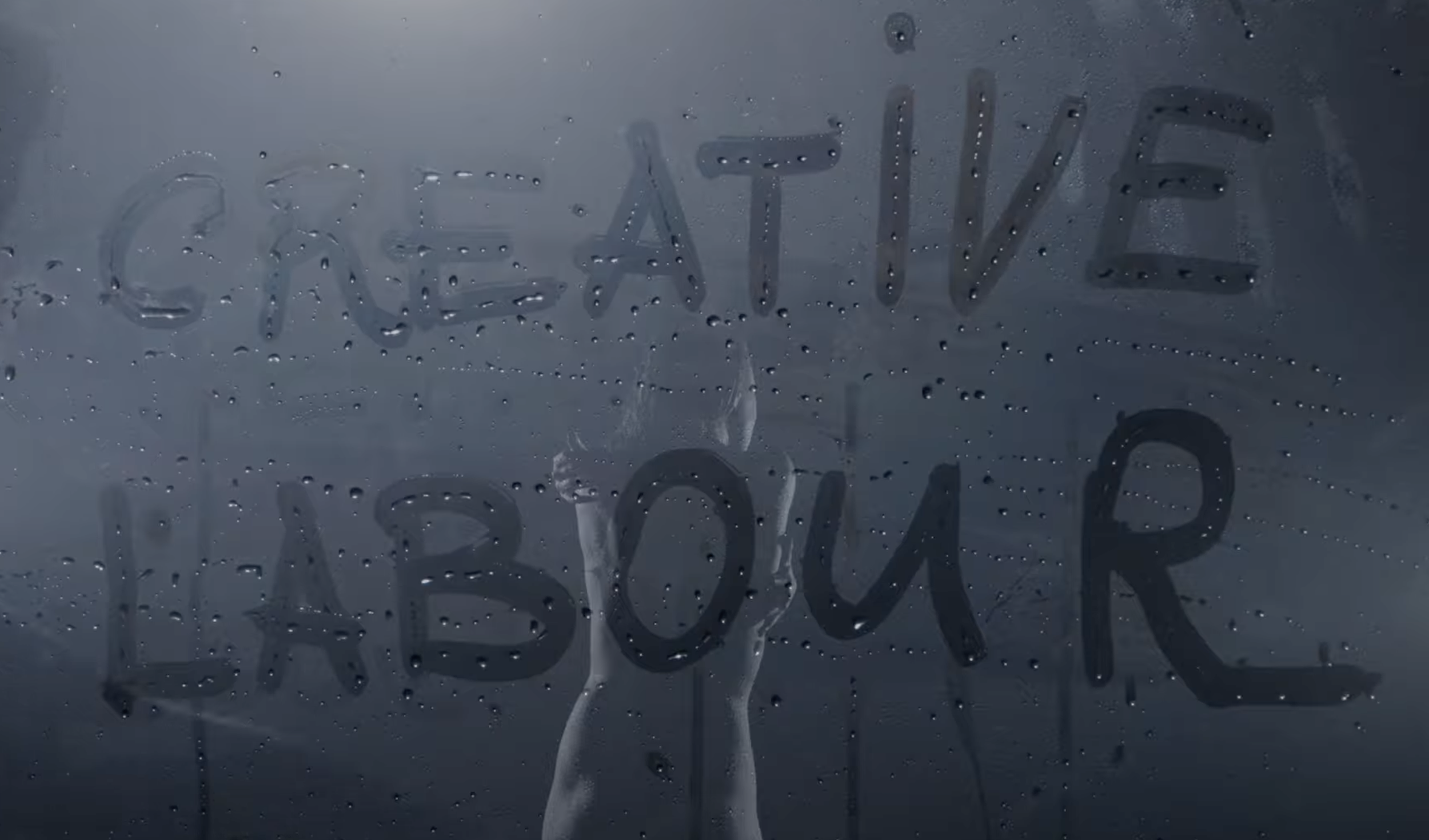
Edlen Lavan, Creative Labour, 2025, screenshot from video
The new media era began in the 1960s and has continued to this day. This was due to a small invention by Sony – their Portapack camera, which allowed anyone to have a portable video recording device without any extra assistance. The fact that by 1965 a TV set had become an average item in an average person’s household made it interesting for a certain group of artists to start experimenting with this medium as a creative art form.
Korean-American artist Nam June Paik was the pioneer in this area. He was the one who decided to purchase a Portapack and create the first video art piece with it, demonstrating to others that a visual artist can easily avoid production studios with numerous personnel to make video footage. This bold move inspired many other practitioners to experiment with the camera: Woody and Steina Vasulka, Bruce Nauman, Valie Export, and many others made their impact on the artistic heritage that we now consider classical for this medium.
Of course, the emergence of a new practice had not gone unnoticed by critics and curators. Such works slowly but stubbornly won their niche in the contemporary art world, manifesting that a true artist cannot be pressured into using a limited number of materials.
Today, we see a growing interest in video as a medium. Many festivals have appeared over time that celebrate this practice. Videonale (Germany), Alchemy Film and Moving Image Festival (UK), Videoformes (France), Now & After (Russia), and many others made it their mission to promote this creative approach globally.
My personal experience in curating this sphere of art can be called peculiar. Over the years, I have constantly been multitasking in academia and curating, unable to choose which to stick with for the rest of my life. Fortunately, in my case, it appeared to transform into a perfect balance between the analytical and the creative. The first part drove me to visit endless exhibitions to find visual research material, and the second part was about noting every interesting piece I would like to exhibit in the future. For a long time, none of this was fully connected with video.
My first serious curatorial work in this area was in 2018 for the Irish Week Festival in Moscow. During that time, the festival’s management had already heard my idea of creating a separate program for contemporary art, yet it was hard to see how it would fit into a program focused on cinema, children's events, and folk dance. However, the silver lining was that it led to a two-hour demonstration by Irish practitioners in a movie theatre. This decision was perfect for introducing a segment of Irish contemporary art to Moscow audiences.
The COVID-19 pandemic became a turning point not only for me but also for many other curators who mostly worked with physical art. In an instant, many of us had to reinvent our practice, where the ephemera component began to impose strict rules.
Going into full online mode can be called not only interesting but also a useful experience. It demonstrated how curatorial practice can flourish not only in a classical white-cube facility but also in the digital space. This meant that major festivals promoting new media art, like The Wrong Biennale, finally got the attention that they deserved.
It is important to note that, even though it may seem that there is no significant difference in the technical aspects of conceiving a show or a theme for a festival, there are certain peculiarities that arise when one works with new media. All of them will be analyzed and described through personal experience, using the example of Nea Techni’s festival, Medium is the Message in Belgrade, which I am honored to curate.
The festival is an initiative of a small group of people passionate about art in all its forms. It was created as a festival that focuses on artistic research within the practice. Of course, it can be said that any work of art has a certain amount of research in it. For the festival, it was decided to focus on themes such as memory studies, psychogeography, hauntology, post-humanism, post-modernism, metamodernism, and art & science. This showed the artists who wanted to apply what kinds of works were more likely to be selected.
The other important part was quite formal – the time restriction. Due to the complex nature of the proposed topics, it was understood that fully unpacking them through the visual material would require at least 10 minutes. That restriction was important to me personally because it was the way to create a slow-motion narrative that many of us miss in times when one-minute-long shorts became visual pests and the main method of communication on social media.
The other major part was dedicating myself to selecting the material. My personal focus is always on how a piece fits the theme and how it can impact the visual narrative of the show. This approach is essential for many of my colleagues in the sphere. It helps to look at each video as a piece of a puzzle and find a place where it will fit, so in the end, you find, by surprise, that this puzzle is 7.5 hours long, as it is in the case of Medium is the Message.
To summarize this slightly too long “short-read” on the curating of time-based media from personal experience, I can say this: each project is always a challenge in order to create a perfect narrative with the help of the artists. Always keep in mind that the audience is very diverse (especially if it is a festival) and needs diverse content, and the most important part is that there can be no visual art festival without the artists.
Alexandra Orlova
Medium is the Message festival curator
Selected artists:
#FFFF00, Anna Afanasyeva, Olga Arkadeva, Johannes Christopher Gerard / Nathalie Launay, Pavel Checkulaev, Ben Dawson, Wenwen Deng, Natasha Dunk, Maxim Imanou Fadeev, Aram Karsi, Edlen Lavan, Dan Li, Yichu Li, Theo Macdonald, Jolene Mok, Maryam Nazari, Mila Nishatova, Vita Plavšić, PollyT, Katherina Sadovsky, Emily Sasmor, Alfiya Shamsutdinova, Ekaterina Shneider, Aaron Alexander Smyth, Guaiwu Sun, tannelvits, Alexander Tarasenko, täuelxsız, Topp & Dubio, Elizaveta Zipunova, Zibeyda Seyidova
Location: KC Grad, Belgrade
Dates: March 3–5, 2026